
What if a building's skin
could clean the air?
How might we design a photocatalytic facade system that actively breaks down NOₓ pollution from AI data centers, turning harmful emissions into harmless byproducts?
How might we design a photocatalytic facade system that actively breaks down NOₓ pollution from AI data centers, turning harmful emissions into harmless byproducts?
Bessemer, Alabama is surrounded by a growing cluster of AI data centers, all of which continuously emit nitrogen oxides (NOₓ) and volatile organic compounds. The community bears this burden disproportionately.
Traditional air filtration is reactive. It traps pollutants and eventually fills up, requiring constant maintenance and replacement. The question this project asked was different: what if the building itself could break pollution down?
“Black people are exposed to greater-than-average concentrations of PM 2.5 from every source — construction, power plants, industrial, residential, cars.”
Tessum et al., Science Advances — Current Pollution Disparities
Exposure disparities by race

Research framework — The Six Pillars of Climate Justice grounded the project's equity lens Source: UC Center for Climate Justice
Traditional air filtration accumulates pollutants until the filter is saturated. Photocatalysis works differently, titanium dioxide (TiO₂) coating activates under UV-A light, generating electron-hole pairs that react with moisture and oxygen to produce hydroxyl radicals. Those radicals attack NOₓ molecules directly, breaking them down into nitrate (NO₃⁻), which washes away in rain, and ultimately into nitrogen gas, oxygen, and water.
UV-A hits TiO₂ coating
Sunlight activates the titanium dioxide on the panel, generating electron-hole pairs in the photocatalytic reaction.
Hydroxyl radicals form
The activated TiO₂ reacts with the air, producing highly reactive radicals that target pollutant molecules.
NOₓ converts to nitrate
NO oxidises to reduce it to nitrogen gas and water through both oxidation and reduction pathways.
N₂, O₂, H₂O remain
The outputs are nitrogen gas, oxygen, and water — harmless to the surrounding community.
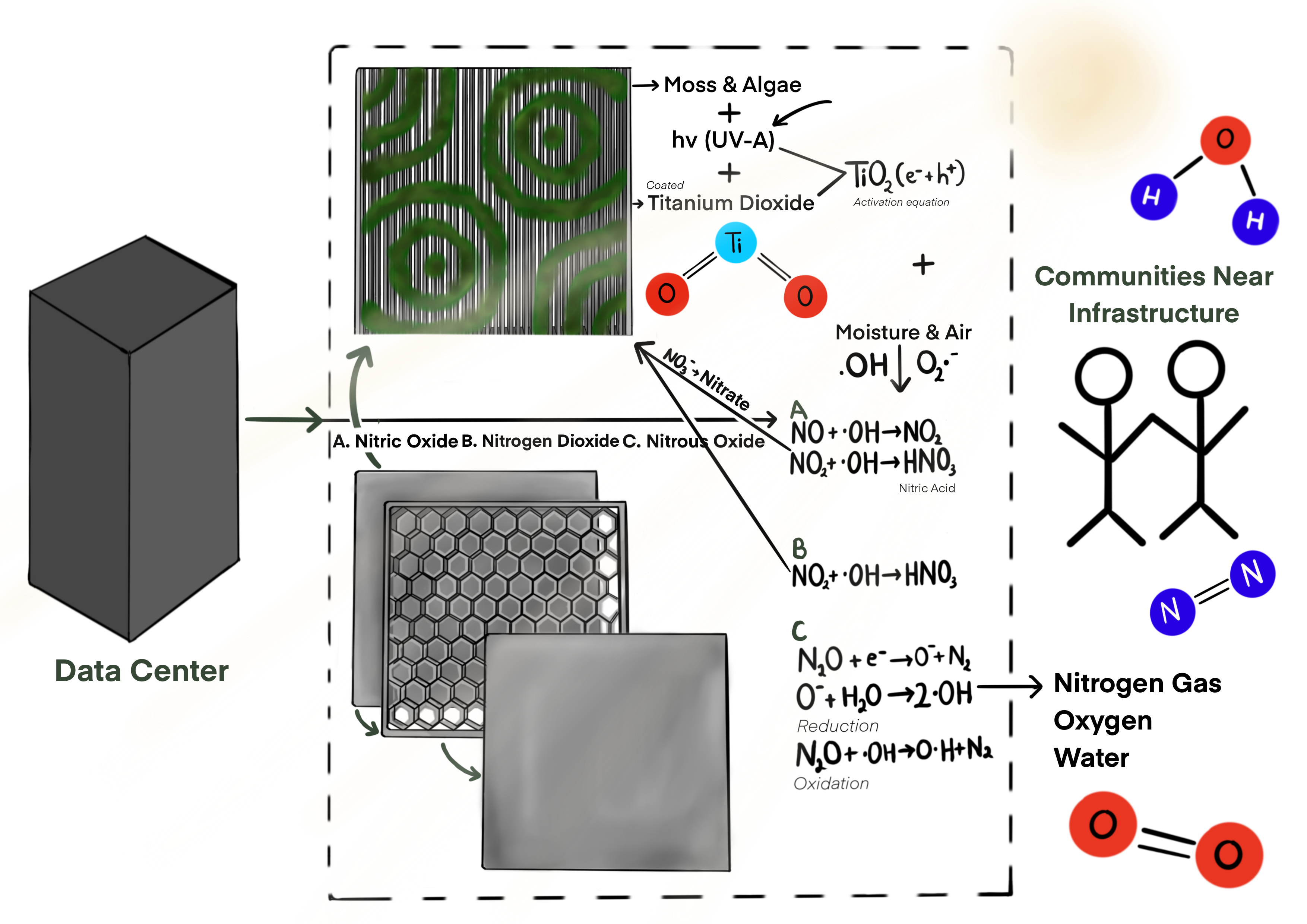
Chemistry diagram — full NOₓ breakdown pathways through TiO₂ activation
The initial ideation phase explored a wide range of applications for photocatalytic chemistry walls. Each concept was evaluated against: could it intercept pollution at the source, could it scale to meaningful impact, and could it serve the community?
The facade panel won on all three. Data centers are among Bessemer's largest NOₓ emitters, their external walls are vast and sun-exposed, and a facade intervention makes the remediation visible.

Early ideation — seven directions explored including road materials, TiO₂ bricks, moss walls, personal masks, and bus shelters
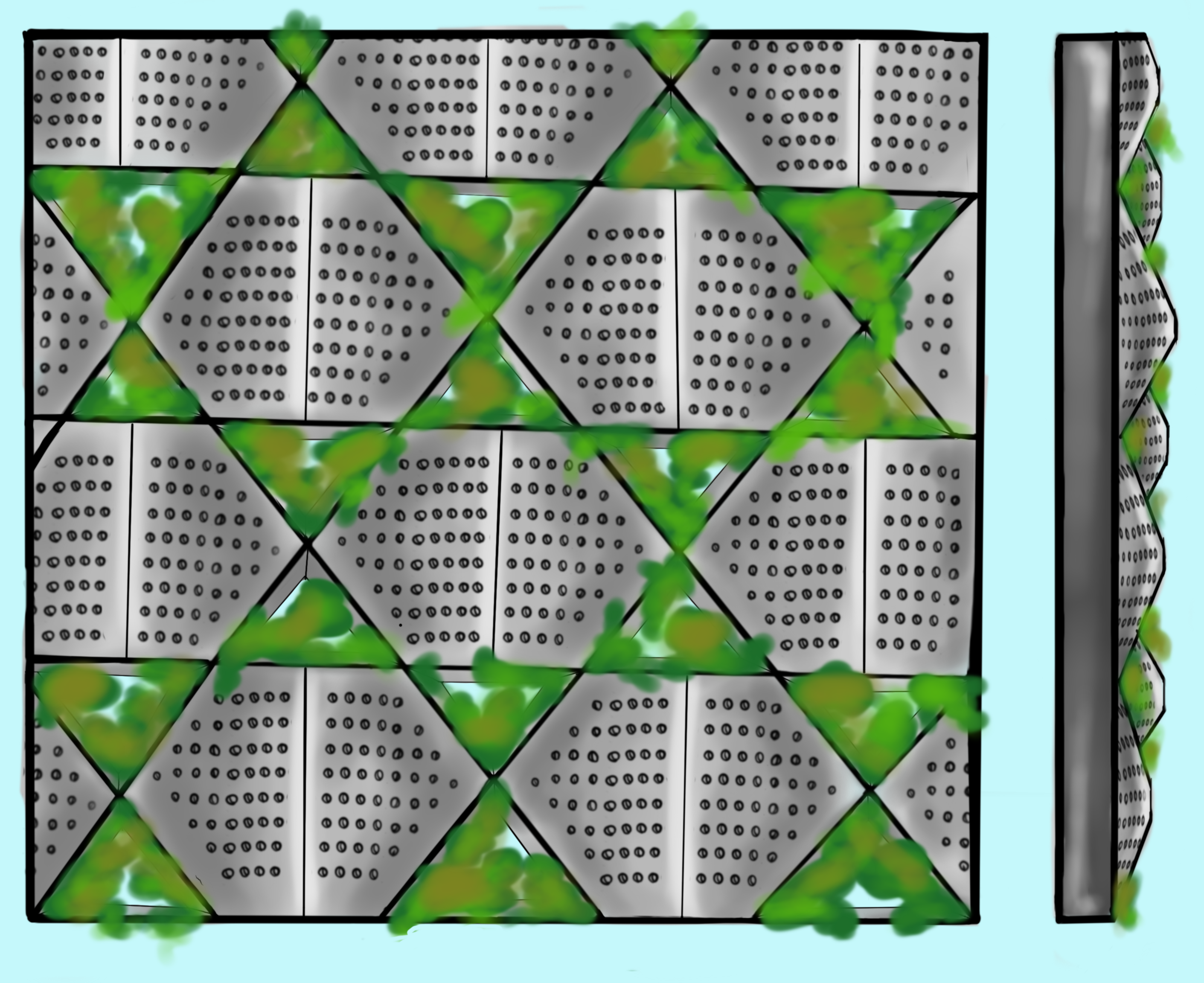
Diamond-grid perforated tile pattern. Maximised surface exposure but read as mechanical and industrial. Tiling across a large facade produced a repetitive, warehouse-like appearance with no relationship to the living biointegration layer.
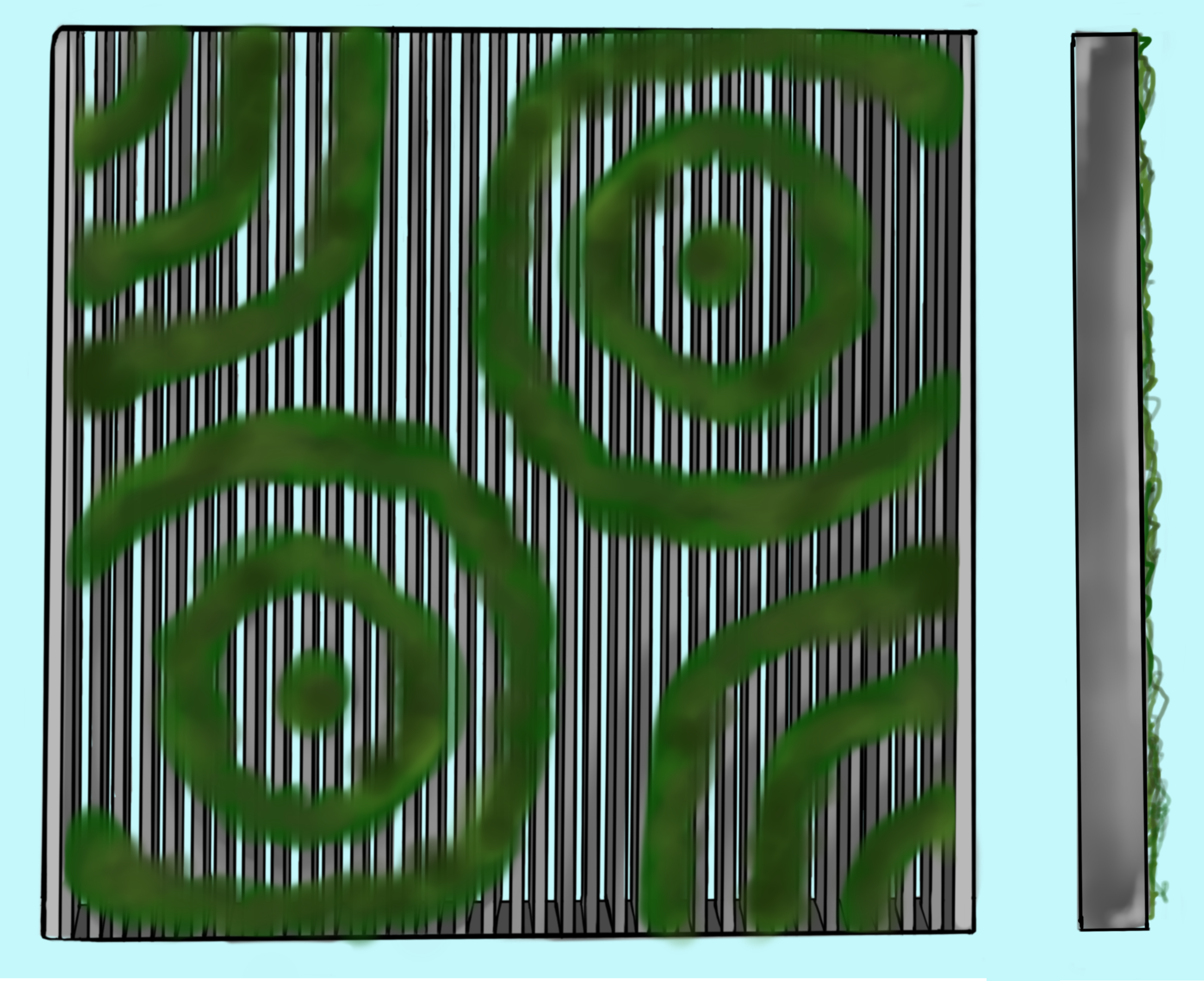
Organic spiral channels cut into a vertical slat face with moss and algae growing through the curves. The biointegration becomes the visible language of the panel — functional and architectural at the same time. Scales naturally across a building facade.
The panel is a layered system designed to mount directly onto existing building facades using rail brackets with a mandatory 1-inch air gap between the panel and the wall. The gap prevents moisture buildup and mold growth while allowing air to circulate through. Each layer has a distinct function, and together they handle photocatalytic decomposition and passive pre-filtration.
Exploded view — passive carbon pre-filter, aluminum honeycomb substrate, and moss/algae facade layer
Honeycomb geometry coated with nano-particle TiO2 maximises surface area exposed to UV light and polluted airflow.
Secondary filtration layer that absorbs NOₓ particles, reducing the concentration load on the TiO₂ coating.
Living biointegration layer provides additional air filtration, protects the TiO₂ coating from UV degradation.
Adjustable brackets attach to existing building facades with a 1-inch mandatory air gap.
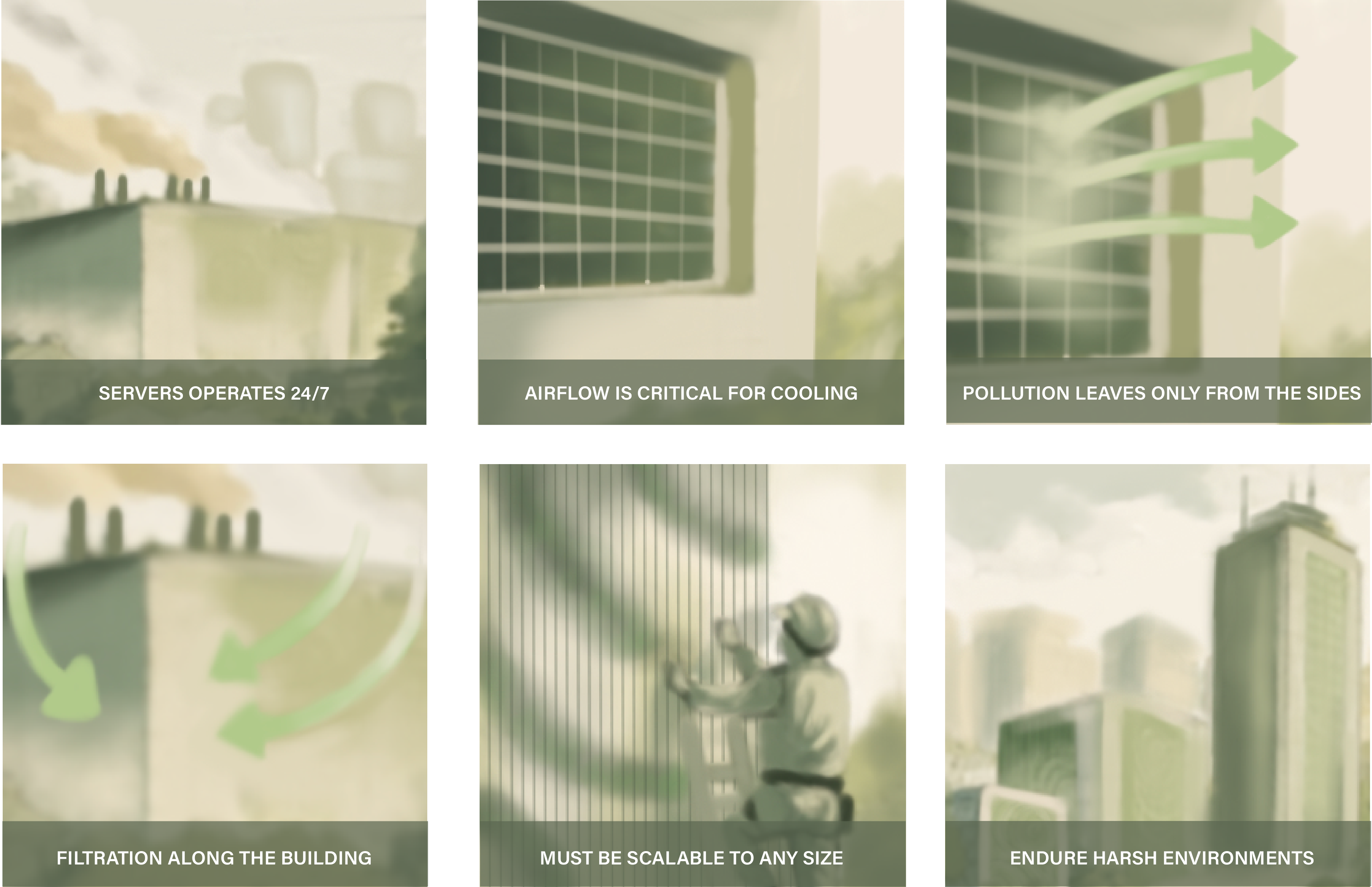
Tradeoff storyboard

System diagram — data center → NOₓ emitted → panel intercepts → TiO₂ + UV-A → N₂ + O₂ + H₂O released
Two physical prototypes: a 3D-printed PLA structure with Titanium Dioxide paste and one without. The honeycomb section was then tested with a UV-A torch and photosensitive test strips to verify UV absorption with the TiO₂-coated surface.
A UV-A torch was shone through the 3D-printed honeycomb to verify that the Titanium Dioxide does absorb UV and the geometry allows sufficient UV-A light to reach the TiO₂ coating behind it. The test compared a TiO₂-coated panel against an uncoated. The coated strip showed a lighter reading. Because TiO₂ requires UV-A activation to initiate photocatalytic reactions, confirming UV absorption was a critical proof-of-concept step.
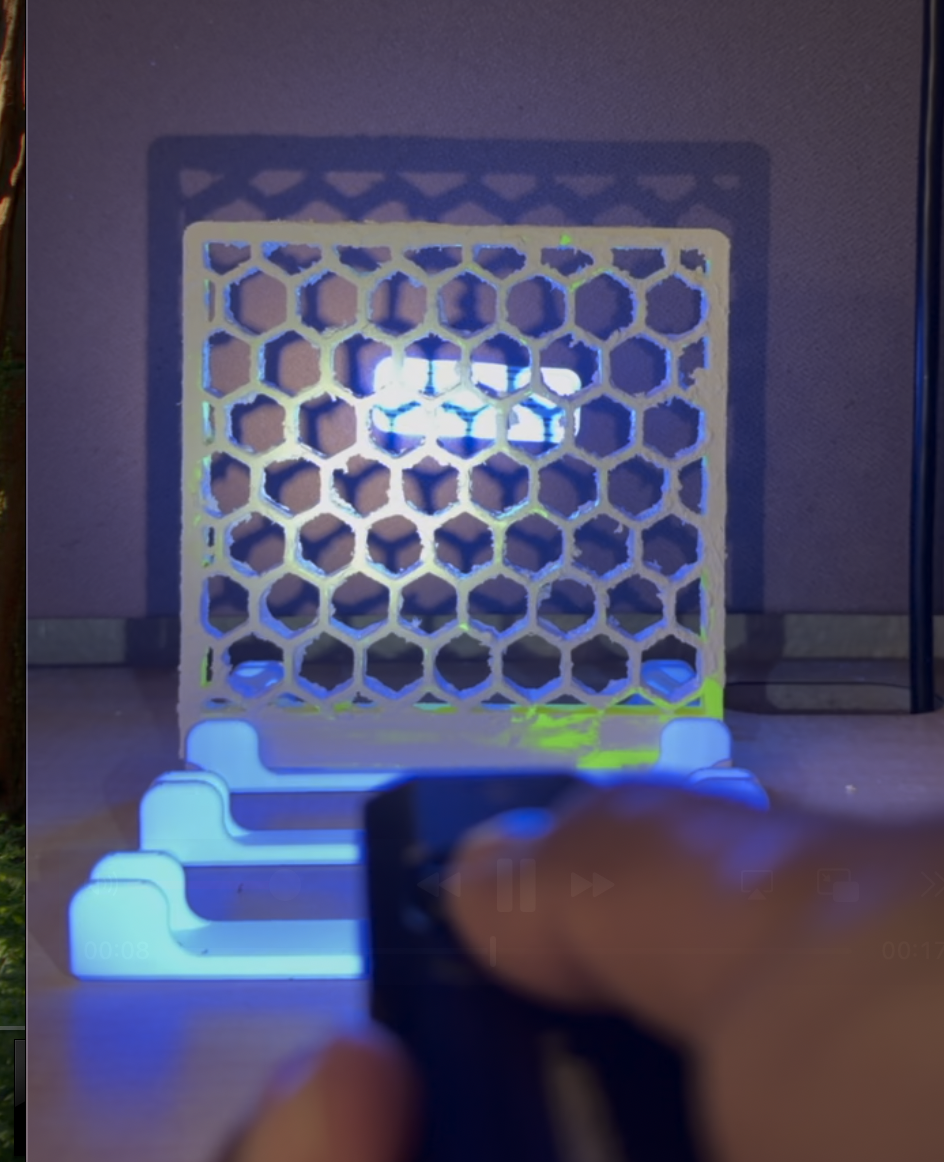
UV-A torch through TiO2 coated honeycomb
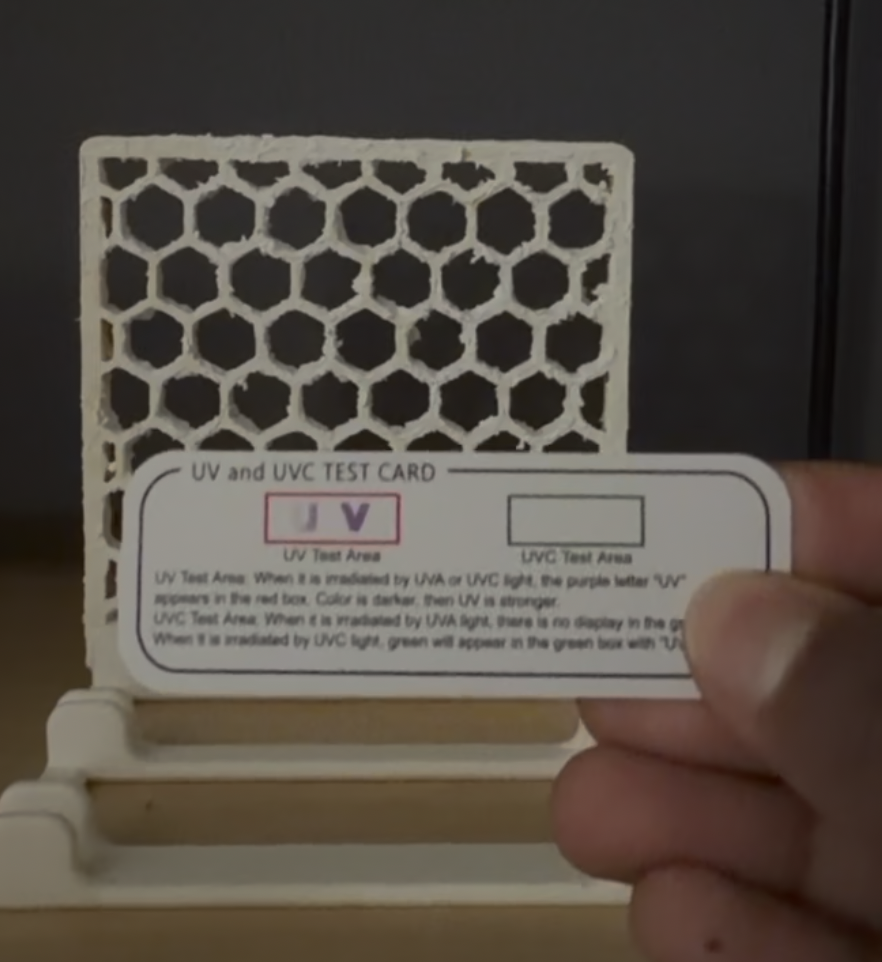
Light UV-A test strip - Confirming TiO2 absorbs UV
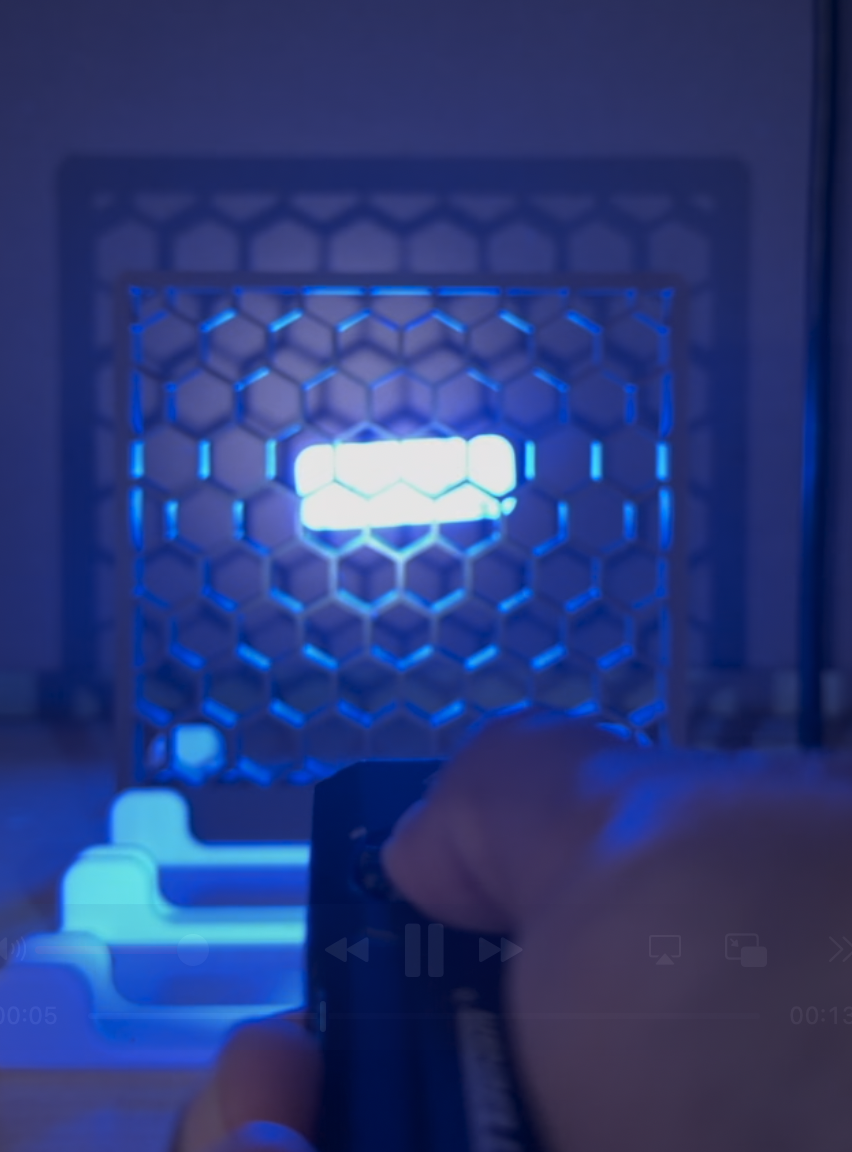
UV-A torch through TiO2 uncoated honeycomb

Dark UV-A test strip - Confirming without TiO2, less/no absorption of UV





At full scale, the panel system wraps an entire data center facade — transforming a blank industrial wall into a living, active remediation surface. The spiral moss channels scale naturally across multiple panels, each one slightly different as the biointegration grows and changes over time. The brushed aluminum slats catch and direct sunlight into the channels, ensuring the TiO₂ coating behind the moss receives consistent UV-A activation throughout the day.
Final panel close-up — aluminum slat structure with moss spiral channels and TiO₂ honeycomb behind
The before/after render shows the same data center site: on the left, exposed brick under a smoke-filled sky, a building that takes from the surrounding air. On the right, the photocatalytic facade in place — the building now actively giving back, breaking down the NOₓ it and neighboring infrastructure produce.

Before / After — exposed brick under polluted sky (left) vs photocatalytic facade system (right)

Current Conditions

Conceptual Future Scenario
Starting from who actually breathes this air, changed every decision. The project wasn't about making a cool panel. It was about making one that served people who had no say in where the data center was built.
Photocatalytic efficiency scales directly with the surface area exposed to UV light. Every geometric decision: the spiral channels, the honeycomb substrate, the slat spacing, was also a chemistry decision. Form and function were inseparable.
Moss and algae aren't aesthetic add-ons. They filter, they protect the TiO₂ coating, and they signal to the community that something is growing. Living materials change over time in ways industrial materials don't.
Watching the test card activate was the moment the project stopped being theoretical. While UV activation was successfully demonstrated, future work would require laboratory testing to quantify NOₓ decomposition rates under real environmental conditions.
No power input, no maintenance cycle, no moving parts. Rain cleans it. Sun activates it. The panel only works because the data center is already there producing both the pollution and the infrastructure to mount the solution on.
Industrial design usually means a discrete object. This project was about transforming an existing structure into an entirely different kind of artifact. The design intervention had to work at architectural scale.

